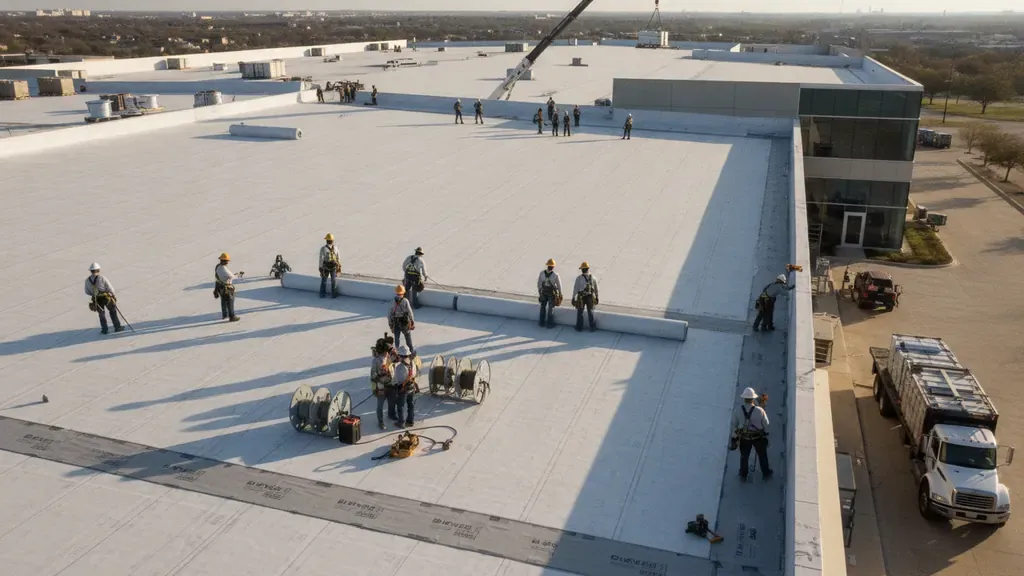
Look down from any office tower in downtown Houston or across the warehouse corridors lining I-35 through Austin, and you will see the same thing on nearly every commercial property: a flat roof. Strip malls, schools, big-box stores, distribution centers, restaurants.The pitched, gabled silhouette that defines most homes almost disappears the moment a building turns commercial. That is not an accident, and it is not just about looks. There are concrete financial and practical reasons flat roofs became the default for commercial construction across Texas.
At Elevation Roofing & Restoration, we install and service flat and low-slope roofs for businesses across more than 100 communities in Greater Houston and the Austin metro. Below are the three core reasons flat roofs dominate commercial buildings, plus what every Texas building owner should understand to make those advantages actually pay off in our climate.
Reason 1: Lower Cost and Faster, Simpler Construction
The economics are the single biggest driver. A commercial footprint is often enormous compared to a house, and a pitched roof over that span gets expensive fast. Every additional plane, hip, and valley adds engineering, framing, and labor. A flat roof flattens that complexity, literally and figuratively.
A low-slope system covers a large area with less structural material and a far simpler framing approach. Crews install it faster, which shortens the timeline and lowers labor costs per square foot. For a developer building a 40,000-square-foot warehouse, that difference is measured in real dollars and weeks.
The savings continue after handoff. A flat roof is easy and safe to walk, so routine roof maintenance, repairs, and equipment service do not require steep-slope rigging on every visit. One caveat that matters in Texas, though: "cheaper to build" does not mean "cheaper to neglect." A flat roof sheds water by design rather than by gravity, so the cost advantage only holds up when the slope, drainage, and seams are done right.
Reason 2: Usable Space the Building Actually Needs
This is the reason most people overlook, and for commercial buildings it may be the most valuable of all. A pitched roof produces an attic, dead volume nobody uses. A flat roof produces a broad, accessible platform, and commercial buildings have a lot of equipment that needs somewhere to live.
- HVAC and rooftop units. Commercial heating and cooling lives on the roof, out of sight and away from tenant space. Texas summers demand serious cooling capacity, and a flat roof is the natural home for those large condensing units and air handlers.
- Solar arrays. A wide, unobstructed flat plane is an ideal canvas for solar panels, an increasingly common move for Texas businesses chasing lower energy bills under our intense sun.
- Mechanical and ventilation systems. Exhaust fans, ductwork, and antennas all mount cleanly on a flat surface and stay hidden behind parapet walls.
- Amenity space. In denser urban cores like central Austin, flat roofs are increasingly built out as rooftop patios and gardens that add real value to office and mixed-use properties.
Putting all of that on the roof frees up the ground footprint and the interior for the business itself. The tradeoff is penetrations: every unit, vent, and mounting point that pierces the membrane is a potential leak source. That is why a thorough roof inspection always pays close attention to the flashing and curbs around rooftop equipment.
Reason 3: Modern Architecture and Clean Lines
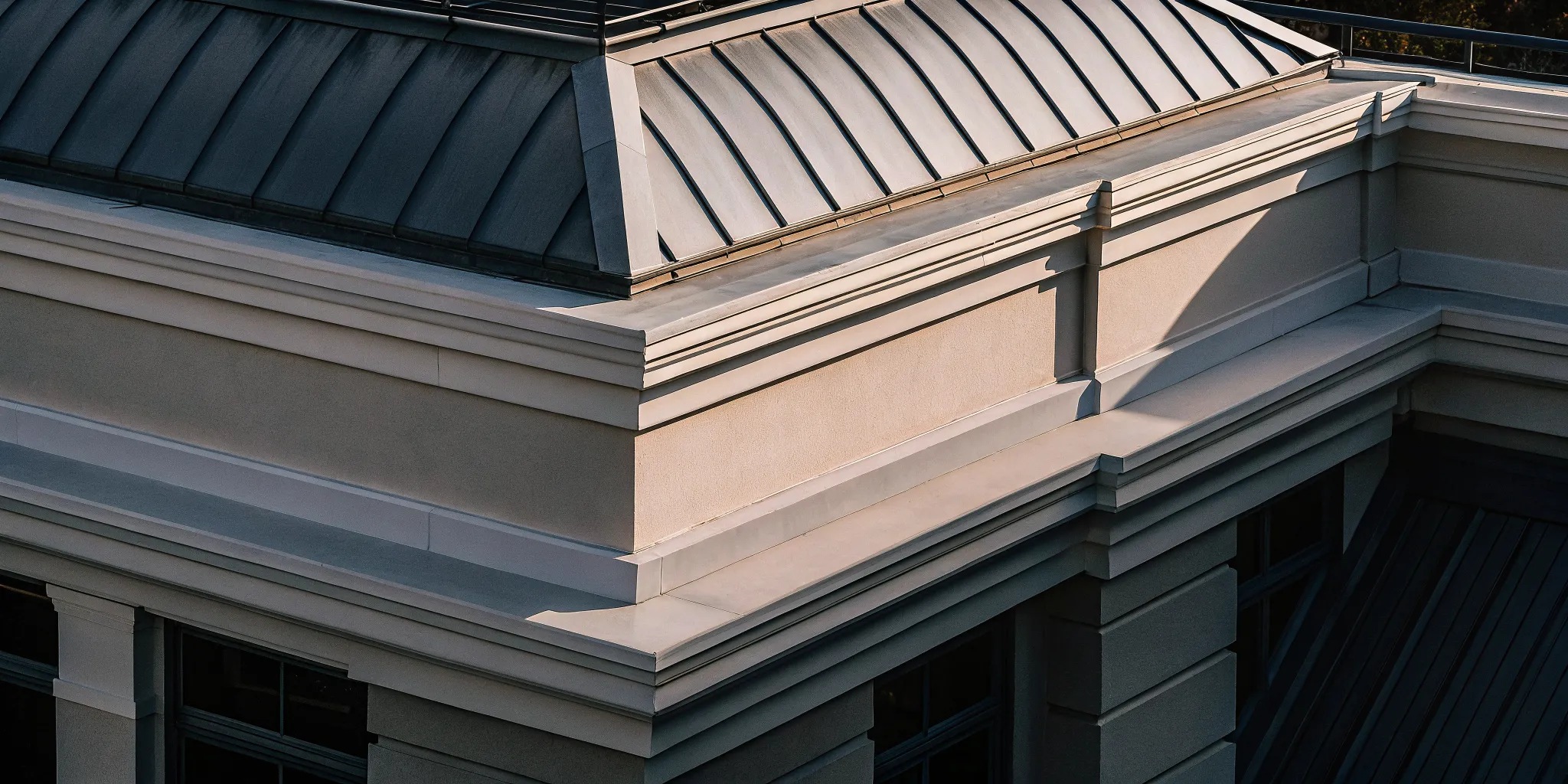
The third reason is aesthetic, and it is more powerful than it sounds. Contemporary commercial design favors clean horizontal lines, large glazing, and a low, grounded profile. A flat roof finishes that look naturally, while a steep pitch would fight it. From the sleek office buildings of the Energy Corridor to the modern retail and restaurant builds rising across East Austin, the flat roofline is part of the brand language of a modern business.
There is a functional bonus hiding in that look, too. A flat roof hides mechanical equipment behind parapet walls, so a building presents a clean face to the street instead of a roofline cluttered with condensers and vents. The aesthetic and the practical reinforce each other, which is a big part of why the style stuck.
The Texas Catch: A Flat Roof Is Only as Good as Its System
All three advantages, lower cost, usable space, and modern looks, are real. But they all assume the roof is built and maintained to handle what Texas throws at it. Our climate is genuinely hard on low-slope roofs:
- Relentless UV and heat bake and embrittle membranes from the top down, year after year.
- Hail bruises and fractures membranes, often without leaving an obvious hole.
- High winds and Gulf Coast tropical storms test every seam and fastener with uplift.
- Heavy rain and humidity punish any spot where water ponds or drainage is undersized.
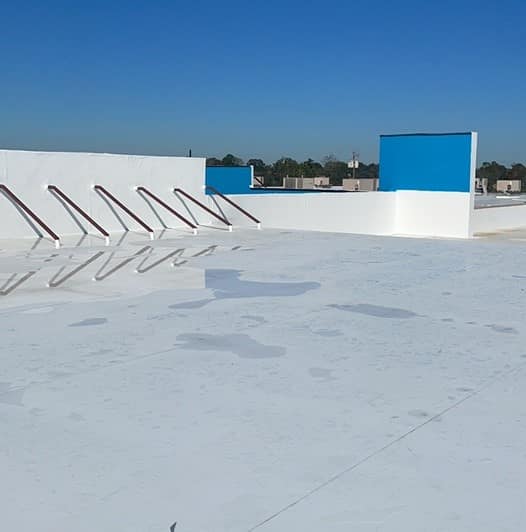
Because a flat roof cannot simply shed water down a slope, three things decide whether it lasts 25 years or fails in 8: proper slope and drainage, meticulous seam and flashing work, and quality insulation that does not trap moisture. Standing water is the enemy of every low-slope roof, and in our humid Gulf climate a system that drains slowly becomes a liability fast.
Choosing the right commercial flat roof system
The membrane you choose determines how well the roof handles Texas conditions. The systems we install most often for commercial buildings:
- TPO, a single-ply, heat-welded membrane that is bright white and highly reflective, cutting cooling load under the Texas sun while its welded seams resist storm uplift.
- Modified bitumen, a tough, multi-layer asphalt system that stands up to foot traffic and equipment service, a smart pick for roofs that get walked often.
- Built-up roofing, the classic layered "tar and gravel" assembly whose surface ballast shields the membrane from UV across large expanses.
Each has its place, and the right call depends on the building, the rooftop equipment load, and the budget. Browse the full range on our roof types overview if you are weighing options for a new build or a re-roof.
Keeping a Commercial Flat Roof Alive in Texas
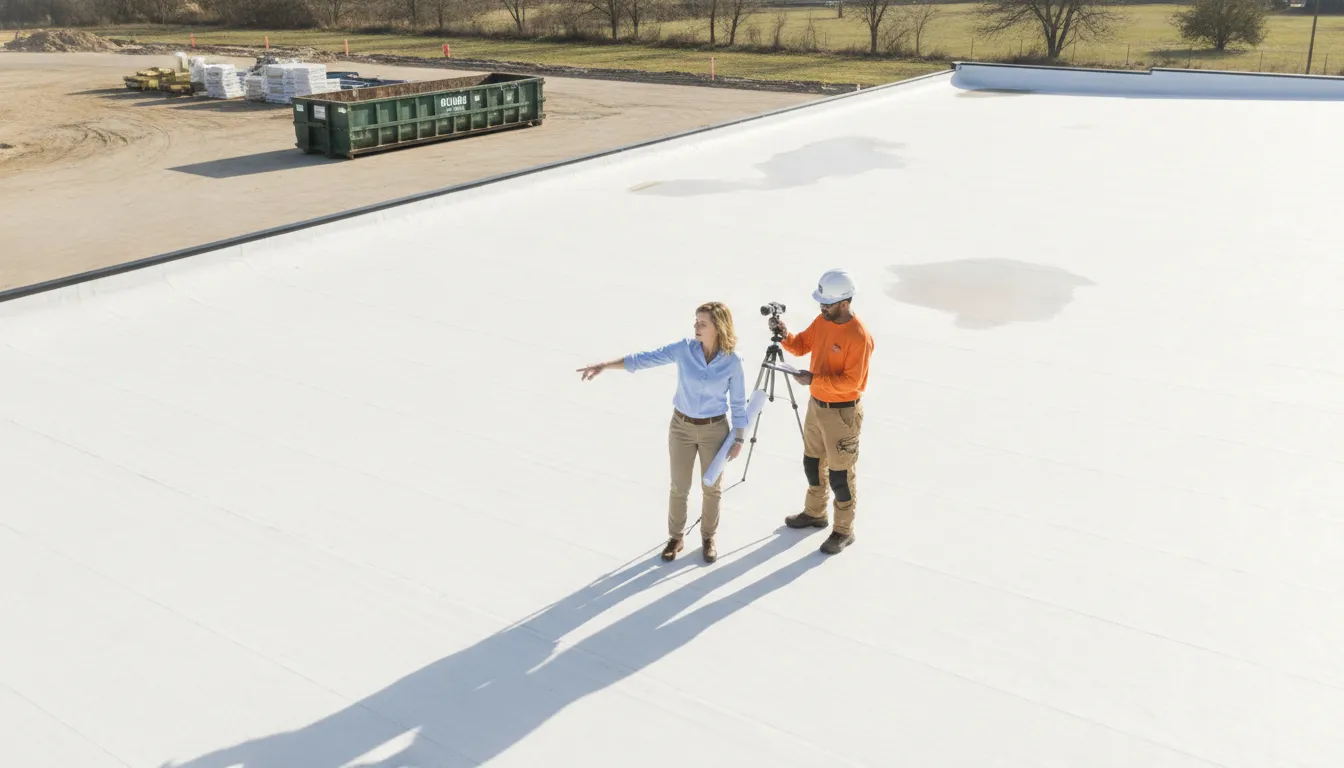
A flat roof rewards attention and punishes neglect more than a pitched roof does, because a small breach has nowhere to drain and quietly soaks the insulation below. A simple discipline protects the investment: inspect at least twice a year plus after every major hail or windstorm, keep drains, scuppers, and gutters clear, address seam and flashing issues the moment they appear, and consider a periodic recoat to extend the membrane's waterproof life. If a storm does hit, our storm damage repair team documents membrane bruising and uplift for your insurance file, and we work directly with carriers on commercial claims.
That discipline is why a flat roof can be a 20-plus-year asset rather than a recurring headache. The look and the cost savings get a business in the door, but maintenance keeps the advantage. Whether your building is in Houston, Austin, or a community between them, a consistent care plan turns a common roof type into a dependable one.
Get a Straight Read on Your Commercial Roof
Flat roofs dominate commercial buildings for good reasons, lower construction cost, usable rooftop space, and clean modern lines, but every one of those benefits depends on a system engineered for Texas heat, hail, and Gulf moisture. As a GAF Preferred Contractor installing GAF lifetime and RhinoRoof-certified systems, with 9-plus years serving the region, a 5-star Google rating, and a 100% satisfaction guarantee, our team builds and maintains commercial flat roofs to go the distance.
Own or manage a commercial building with a flat roof? Schedule your free roof inspection, a $399 value, or contact us and we will give you an honest assessment of your low-slope system and what it needs to last.