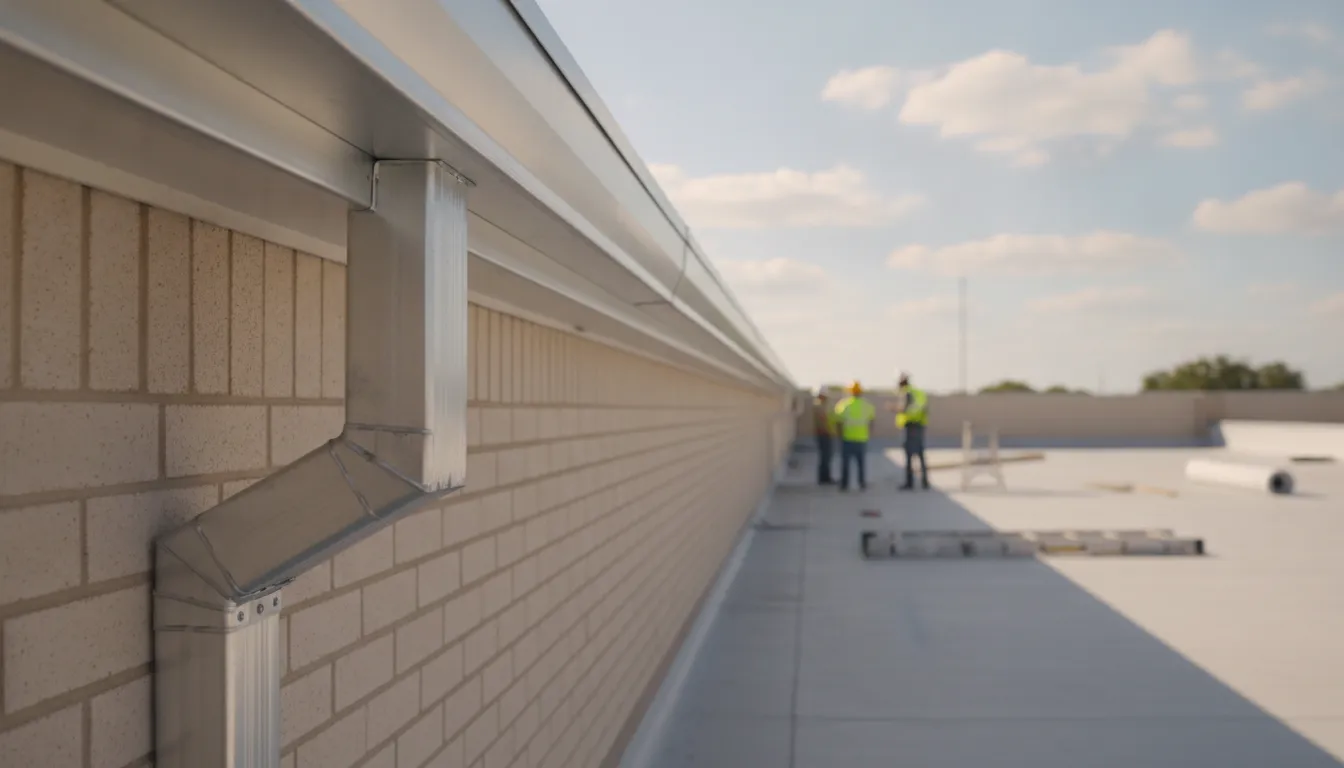
A short afternoon storm in Houston can dump more water on a flat commercial roof than a 5-inch house gutter was ever built to move. Sizes of guttering decide whether that water leaves through a downspout or spills over the fascia, soaks the wall, and ponds beside the slab. The right width is a drainage choice, not a catalog default.
Get a quote for commercial gutter systems sized to your roof.
This guide is for Texas property owners comparing gutter width, downspout size, and outlet spacing before they call for installation. It does not price a project, and it is not a do-it-yourself install manual. Elevation Roofing & Restoration inspects the roof edge, measures the area that feeds each run, and recommends a system that matches the building. The same crews handle roof installation and repair when the edge and the roof need to be planned together.
What Do Sizes of Guttering Mean on a Commercial Roof?
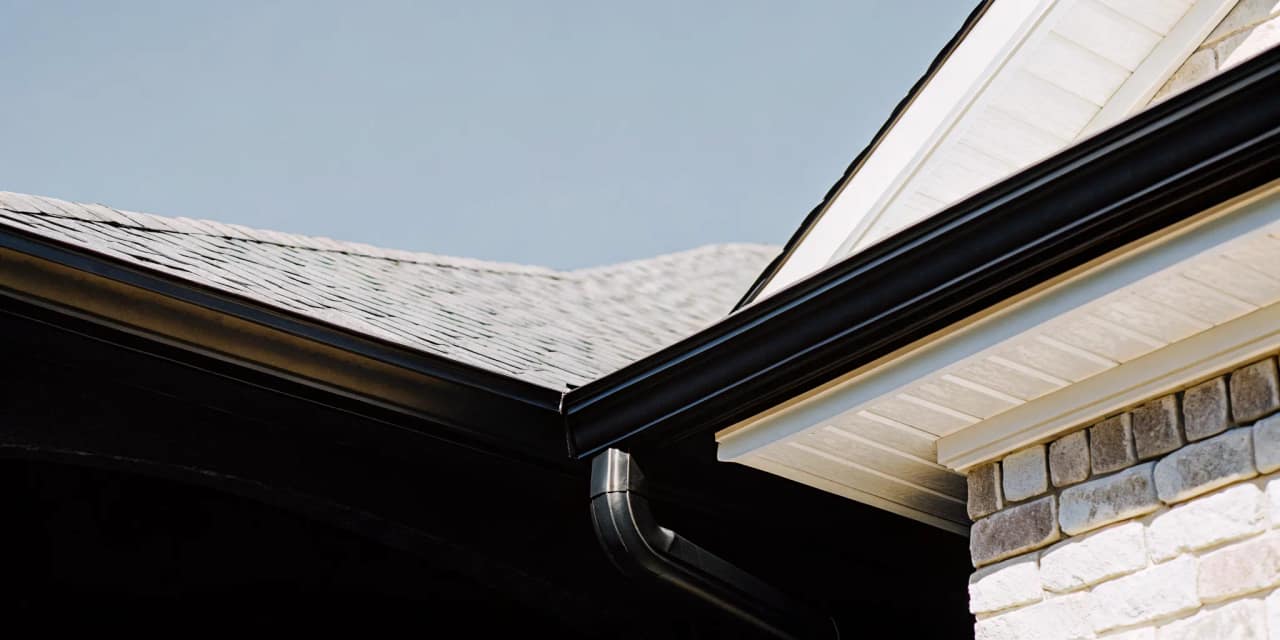
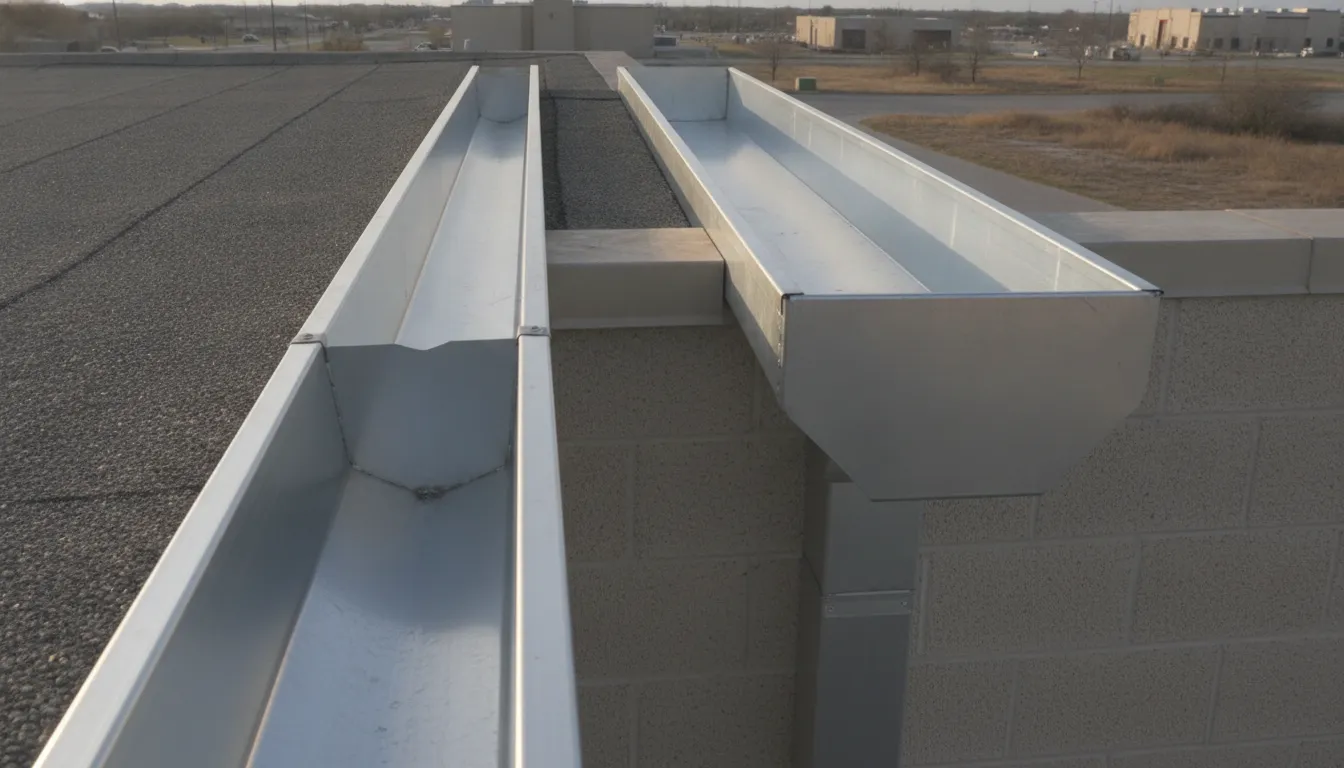
Gutter size is the width of the trough across the top, measured in inches. A 5-inch K-style gutter is the common house size. A 6-inch K-style holds more water in the same length of run. Commercial box and cornice gutters go wider still, and they are often built into the roof edge instead of hung on a fascia board.
Width is only half of the system. The downspout is the outlet, and an undersized outlet will back water up into a correctly sized trough. Industry sizing guides pair the common sizes like this:
- 5-inch K-style with a 2-by-3-inch downspout. Fine for many houses. Tight on a large or steep roof in a Gulf storm.
- 6-inch K-style with a 3-by-4-inch downspout. The usual step up where rain arrives fast, including much of the Houston area.
- Commercial box or industrial gutter with larger rectangular conductors. Built for long roof edges, low-slope roofs, and big drainage areas.
Half-round gutters of the same nominal width hold less than K-style, because the round profile has a smaller cross-section. On a retail or warehouse roof, that difference shows up as overflow during the first hard burst, not as a style preference. Our types of gutters guide covers profiles and materials. This page stays on how much water each size can move.
How Much Roof Can Each Gutter Size Handle?
Size the gutter to the roof area that drains to one downspout, not to the whole building. A 20,000-square-foot warehouse with eight well-placed outlets is a different problem from a 4,000-square-foot wing that all slopes to one long run.
Published capacity charts, including the planning tables summarized by The Roofing Brief, rate K-style gutters at about 1 inch of rain per hour. See the comparison below.
| Profile. | About gallons per foot. | Roof area per downspout at 1 in/hr. | Same area at 2 in/hr. |
|---|---|---|---|
| 5-inch K-style. | 1.2. | About 1,200 sq ft. | About 600 sq ft. |
| 6-inch K-style. | 2.0. | About 2,000 sq ft. | About 1,000 sq ft. |
| 7-inch K-style. | 2.8. | About 3,000 sq ft. | About 1,500 sq ft. |
| 5-inch half-round. | 1.0. | About 900 sq ft. | About 450 sq ft. |
| 6-inch half-round. | 1.4. | About 1,400 sq ft. | About 700 sq ft. |
Those figures are planning ratings, not a building-code stamp and not a quote. Double the rainfall intensity and you cut the supported roof area roughly in half. A 5-inch gutter that is fine in a light shower can overflow in the storm that matters.
One inch of rain on one square foot of roof is about 0.62 gallons. A 1,200-square-foot drainage area at 1 inch per hour is roughly 750 gallons an hour, or about 12 gallons a minute. If the downspout cannot pass that flow, the trough fills and water sheets over the front lip.
Plumbing codes size roof drainage from local rainfall intensity and gutter slope, not from a single national square-foot number. This Old House walks through the same idea for houses: drainage area, pitch, and how fast water can leave. Use the chart above to frame the conversation. Let a measured roof and local rainfall pick the size.
Why Does Texas Rain Change the Size You Need?
Houston and Austin do not drain like a dry inland city. NOAA Atlas 14 raised official rainfall-frequency values across Texas. Around Houston, the 100-year, 24-hour total moved from 13 inches to 18 inches. In Austin, the same duration rose by as much as 3 inches, up to 13 inches. Short bursts inside those storms are what overflow a gutter.
A heavy Gulf thunderstorm can drop on the order of 2 inches in an hour. At that rate, the 1-inch-per-hour column in the table is already optimistic. Property owners along the coast, and across Central Texas, often need one size larger than a national "standard house" chart suggests. That is why a 6-inch gutter with 3-by-4-inch downspouts is the practical Houston default for many larger roofs. A long commercial edge may need a box gutter instead.
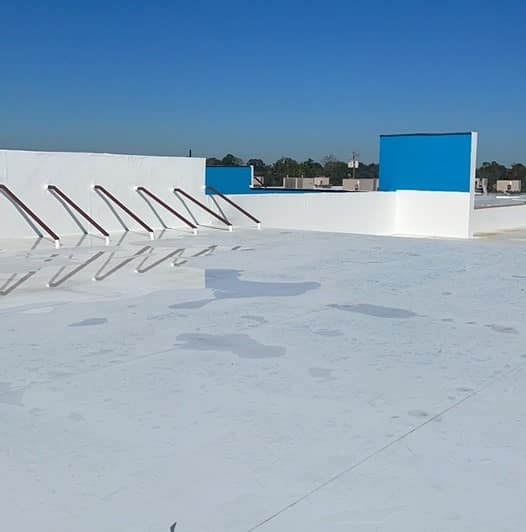
Pitch changes the load too. A steep metal roof throws water at the gutter faster than a low-slope TPO roof of the same area. Valleys dump two planes into one point. A small entry canopy under a valley can overflow a 5-inch gutter while the rest of the building looks fine.
- Long, low-slope commercial edges collect a wide sheet of water. Width and outlet count both matter.
- Steep roofs and valleys need extra capacity at the point where water arrives, not an average across the whole roof.
- Trees, HVAC condensate, and flat debris reduce the open area of the trough. A gutter that is "big enough" on paper can still overflow when it is half full of leaves.
If the roof itself holds water before it ever reaches the edge, fix that path first. Our guide to flat roof drainage in Texas covers internal drains and scuppers. Perimeter guttering is the next step, once water is actually leaving the membrane.
How Should You Match Downspouts to Gutter Width?
A wide gutter with a small outlet is a funnel with a pinched neck. Most residential downspouts are 2 by 3 inches, and they are commonly rated near 600 square feet of roof at moderate rainfall. A 3-by-4-inch downspout roughly doubles that, which is why it belongs with 6-inch gutters. Commercial conductors are larger again, and they are spaced to the calculated flow, not to a decorative rhythm.
Ask these questions before you approve a size:
- How many square feet drain to this run, including valleys that feed it?
- What rainfall intensity are we designing for, not the average rainy day?
- How far is it between downspouts, and where does each outlet discharge?
- Is the gutter pitched toward the outlet, or is it level and holding water?
- Will a guard, screen, or debris cut the open capacity?
Outlet location matters as much as outlet size. Water that dumps against the foundation undoes the point of the gutter. On a storefront or office, we look for a discharge point that clears doors, walks, and landscaping, then confirm the conductor can pass the storm. Elevation installs and replaces downspouts as part of commercial gutter systems, including leak sealing and fascia repair when the edge has already been wet.

Which Gutter Size Fits a Texas Commercial Building?
Use the building, not a single product name. These are starting points we talk through on site. They are not a promise that one size fits every address.
- Small office or house-scale roof, light tree cover: 5-inch K-style can work if each downspout sees well under 1,200 square feet and storms stay moderate. In Houston, we still check the 2-inch-per-hour case before we leave it there.
- Typical Houston or Austin commercial edge: 6-inch K-style with 3-by-4-inch downspouts. More volume per foot, fewer overflow complaints in a fast storm.
- Warehouse, retail strip, or low-slope roof with long runs: a commercial box or industrial gutter, sized from roof area and rainfall, with conductors placed for the flow. Hanging a house gutter on that edge is the usual reason water sheets down the wall.
- Steep metal or tile above a high eave: start at 6 inches even when the square footage looks modest. Water arrives faster, and half-round of the same width holds less.
Seamless aluminum is the material we install most often on Texas buildings, because a long run has seams only at corners and outlets. Steel and formed commercial profiles show up when the edge detail or the span calls for them. Material choice is covered on the types page. It does not replace the capacity math.
If gutters are already overflowing, sagging, or staining the facade, the size may be wrong, or the outlets may be too few. Our gutter service page lists those warning signs and the work we do after an inspection: cleaning, leak sealing, installation, and downspout replacement. A maintenance plan for the roof above the gutter is a separate decision, covered in our commercial roof maintenance plan.
Schedule a free roof and gutter inspection in Houston or Austin.
What Should You Ask Before You Request a Quote?
Bring the building, not a guess at inches. A useful quote starts with the drainage area, the roof type, and the places water already misbehaves.
- Roof area and pitch for each section that feeds the edge, including valleys.
- Photos of overflow stains, ponding at the wall, and any sagging or open seams.
- Where downspouts discharge today, and whether that water reaches a walk, a door, or the slab.
- Whether storm damage is part of the story. If a covered claim is involved, we meet the adjuster and carry the repair. We do not invent coverage.
Elevation Roofing & Restoration is a residential and commercial roofing company serving Houston, Sugar Land, League City, and Austin. Crews are in-house. The company is Owens Corning and GAF Certified, and public reviews are shown as a 5.0 Google rating. Gutter inspection, installation, replacement, and downspout work sit with the roof edge, not as an afterthought. Service consultants walk the options after the inspection and give an estimate from the measured roof.
We do not publish a universal price per foot for commercial guttering. Roof area, height, fascia condition, and outlet count move the number. Financing for qualifying projects is available through the financing page, up to $25,000, subject to credit approval. That is a payment option, not a gutter price.
When you are ready, start with the gutter page or a free inspection. We will tell you whether the current size can stay, or whether the edge needs a wider trough and larger conductors.
Request a quote for gutter sizing and installation.
Frequently Asked Questions
What is the normal size of a gutter?
On houses, 5-inch K-style is the usual size, often with a 2-by-3-inch downspout. Many Houston and Austin roofs do better with 6-inch gutters and 3-by-4-inch downspouts because storms are intense. Commercial edges often need a still wider box gutter.
Are 5-inch or 6-inch gutters better in Texas?
Six-inch gutters move more water per foot, about 2 gallons versus about 1.2 for 5-inch K-style. On a large roof, a steep slope, or a Gulf storm, 6-inch with larger downspouts is the safer residential and light-commercial step. A small roof with short runs can still be fine at 5 inches.
Are most downspouts 2 by 3 or 3 by 4?
Most house downspouts are 2 by 3 inches. They match 5-inch gutters and smaller drainage areas. A 3-by-4-inch downspout pairs with 6-inch gutters and handles roughly twice the roof area. Commercial conductors are sized from the calculated flow, not from the house default.
How many downspouts does a commercial gutter need?
Count them from roof area and rainfall, not from a fixed spacing. A common field check is an outlet every 30 to 40 feet. Then adjust when a valley or a long run dumps more water than that spacing can pass. Too few outlets will overflow a gutter that is otherwise wide enough.
Can Elevation size gutters for a Houston or Austin commercial building?
Yes. We inspect the roof edge and measure what drains to each run. We then recommend gutter width and downspout size for homes and commercial properties in Houston, Sugar Land, League City, and Austin. Call (832) 271-1726 or request a quote from the gutter services page.