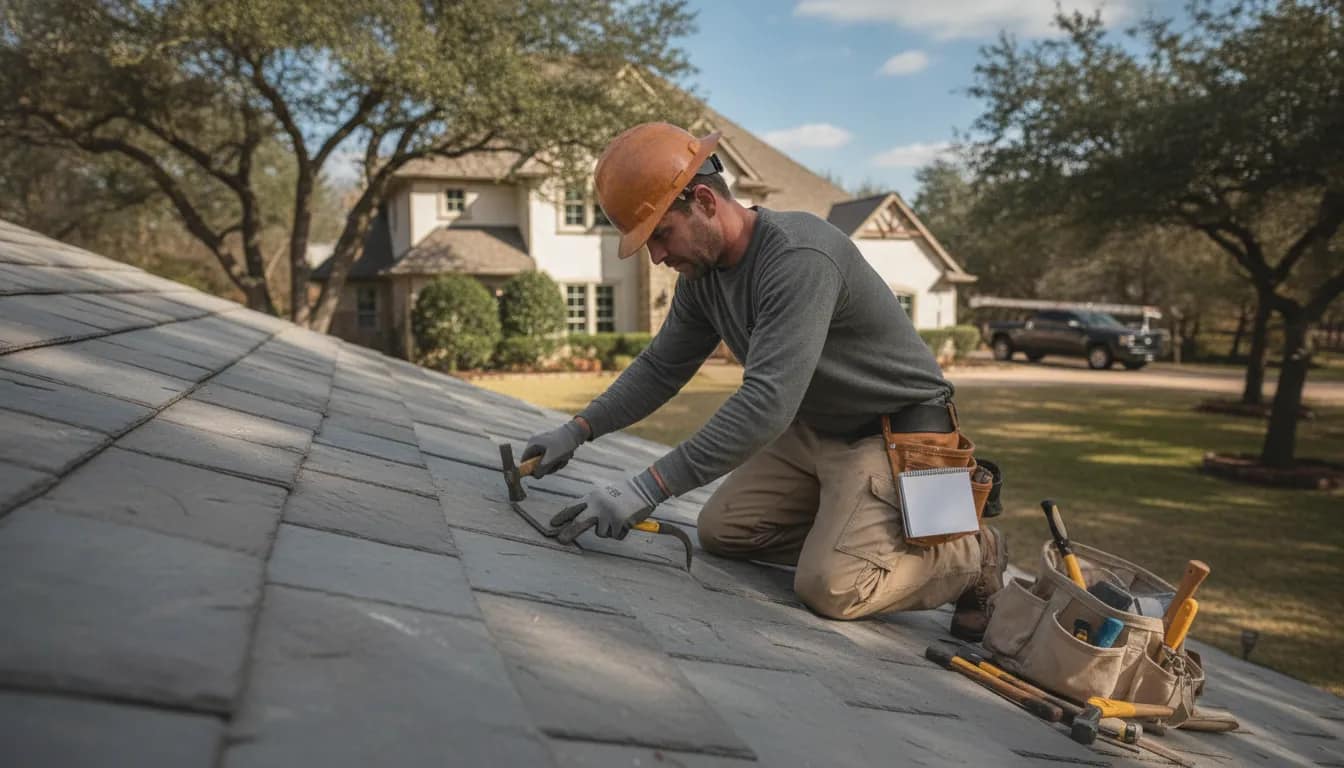
A slate roof can look sound from the driveway while a loose tile, failed flashing, or hidden moisture is already creating a path for water. Texas weather adds practical urgency. High winds, hail, heavy rain, and falling branches can all expose weaknesses around roof edges, chimneys, valleys, and drainage components. Do not climb onto slate to investigate. Look from the ground, note visible changes, and arrange a qualified evaluation.
Call Elevation Roofing & Restoration at (832) 271-1726 for a free roof inspection and estimate.
Slate roof repair may involve securing or replacing individual slates, addressing flashing or ventilation problems, correcting leaks, or planning broader restoration. Whether a limited repair is appropriate depends on the roof's age, installation, underlying components, and the extent of damage. A professional inspection can help separate a manageable issue from conditions that warrant replacement, without relying on a one-size-fits-all rule.
For owners in Houston, Austin, and surrounding Central Texas communities. The first step is understanding which warning signs deserve prompt attention and which observations should be left to a roofing professional.
What Damage Should Texas Property Owners Look For on a Slate Roof?
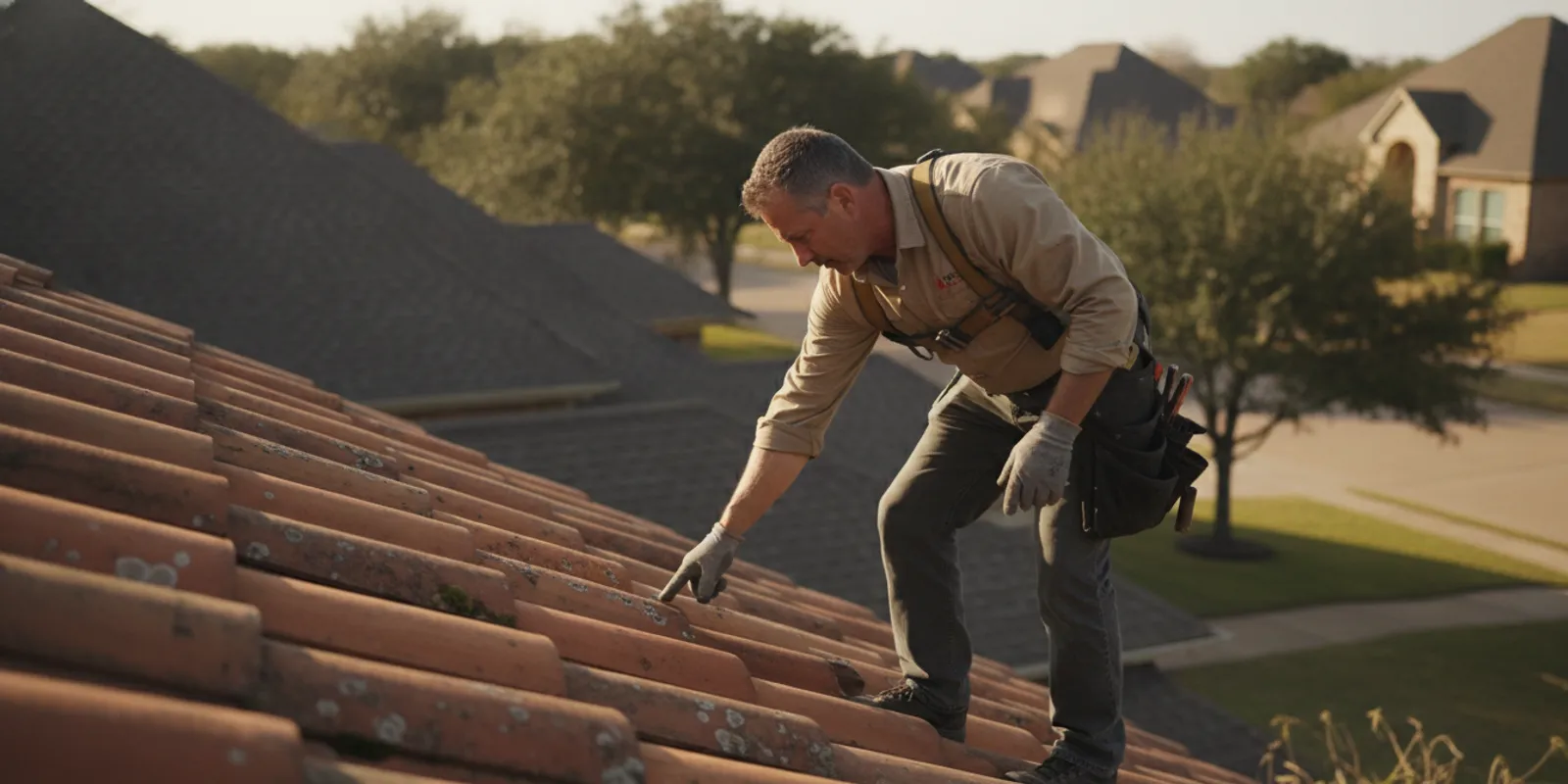
Start from a safe position on the ground after severe weather or whenever you notice a new ceiling stain. Slate can crack, loosen, or slip while the roof structure and interior remain difficult to assess from below. Look across the roof with binoculars if needed, but do not climb a ladder onto the roof or walk on slate. Individual pieces can break under pressure, and a professional can inspect areas that are not visible from the yard.
Visible changes do not always identify the full problem. A missing or broken slate may allow water into the layers beneath it, while the actual leak appears near a ceiling, wall, chimney, or upper-floor trim. Flashing, the metal material that protects joints around chimneys, valleys, walls, and roof edges, can corrode or pull away over time. Deteriorated underlayment may also contribute to water intrusion even when the slate surface looks mostly intact. These conditions call for diagnosis rather than a quick patch based only on the first stain.
Ground-level signs worth documenting
- Cracked, broken, or visibly missing slate pieces.
- Rows that look uneven, with tiles that appear loose or slipping.
- Dark moisture marks, active drips, or recurring stains in ceilings and upper walls.
- Exposed or damaged flashing near chimneys, valleys, dormers, and roof edges.
- Slate fragments, fasteners, or other roofing debris in gutters or around the property.
- Blocked drainage areas, overflowing gutters, or water collecting where it should flow away.
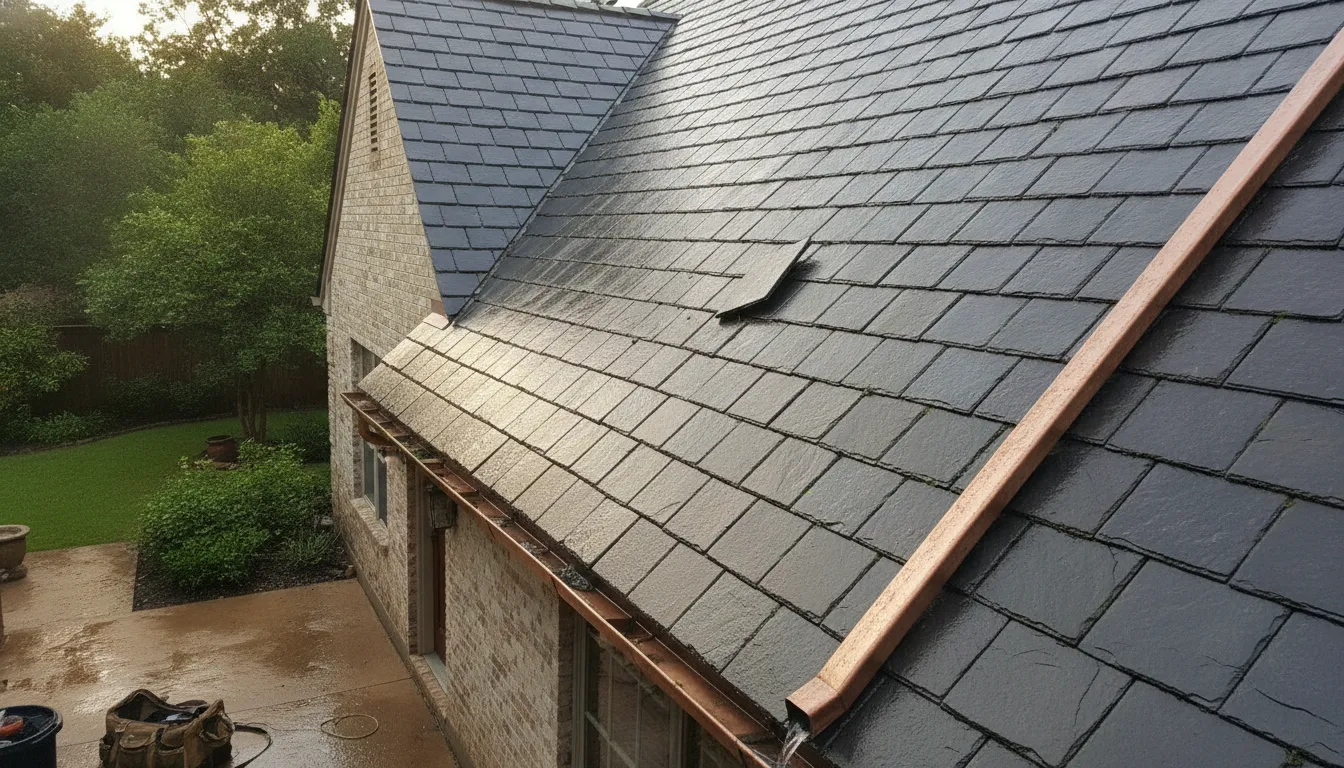
Storms are a common trigger for slate damage. High winds, hail, heavy rain, and falling branches can crack tiles, dislodge pieces, or damage flashing. A storm can also reveal an older installation or maintenance issue that had not yet caused an obvious leak. If the damage followed a weather event, photograph what you can safely see from the ground, note when you first noticed it, and avoid moving roof materials yourself. Elevation Roofing provides storm damage assessment and restoration support, including documentation assistance when an insurance claim may be involved. Assistance does not guarantee an insurance decision or payment.
Drainage deserves attention because leaves, branches, and debris can obstruct gutters and drains, allowing water to back up toward vulnerable roof details. Routine maintenance may include debris removal, drainage clearing, flashing inspection, and minor repairs, but the appropriate scope depends on the roof's condition. A qualified inspection can review the slate surface, fascia, soffits, gutters, drains, vents, flashing, and signs of moisture or water ingress. To move from warning signs to a documented plan, schedule a free roof inspection for your Houston, Austin, or surrounding Central Texas property.
When Is Slate Roof Repair Practical, and When Is Replacement Considered?
The table below is a planning framework, not a diagnosis. A professional must confirm the condition of the full roof system.
| Condition found | Possible direction | What the assessment should clarify |
|---|---|---|
| Localized broken or loose slates. | Targeted repair. | Whether surrounding slate and supporting components remain sound. |
| Flashing, drainage, or moisture concern. | Repair or maintenance. | Where water is entering and which related components need attention. |
| Widespread deterioration or recurring leaks. | Restoration or replacement review. | Which areas can be preserved and why a broader scope is practical. |
The right decision depends on the condition of the slate and the roofing system beneath it, not simply on the roof's age. A professional evaluation can separate a limited repair from a broader restoration or replacement plan. A few broken or loose slates, localized flashing problems, or an isolated leak may be manageable when the surrounding roof remains sound. By contrast, widespread deterioration, recurring water intrusion, or problems affecting the underlying structure may make replacement worth considering.
Age provides useful context, but it is not a universal cutoff. The National Park Service explains that properly installed slate roofs can last 60 to 125 years or longer, depending on the slate, roof configuration, and location. It also notes that some slates have lasted more than 200 years. Those figures describe potential durability, not a promise for every roof in Houston, Austin, or elsewhere. Installation quality, weather exposure, maintenance, flashing, fasteners, underlayment, and prior repairs all affect the current condition.
The customer knowledge base likewise describes slate as a material that may last 30 or more years when conditions and maintenance are favorable. Read the National Park Service guidance on slate roofs for historical preservation context.
When targeted slate roof repair may make sense
Repair is often considered when damage is localized and the larger system can continue performing after the affected components are addressed. An assessment may look for broken, missing, or loose slates, failed flashing, ventilation concerns, drainage problems, and signs of moisture intrusion. Repairs may also be appropriate after a storm when the damage is confined to particular areas. In that situation, the goal is to correct the source of the problem and protect adjacent materials, rather than replace sound portions of the roof unnecessarily.
Historic properties require additional care. The National Park Service states that historic slate roofs should be repaired rather than replaced whenever possible because their pattern, detailing, and craftsmanship are important design elements. That guidance supports a preservation-minded approach, but it does not remove the need for a project-specific inspection. A roof may need restoration planning even when individual slates appear repairable.
When replacement deserves consideration
Replacement enters the conversation when the roof has extensive damage, persistent leaks, widespread deterioration, or conditions that make repeated limited repairs impractical. It may also be considered when the roof is beyond cost-effective repair, but that phrase must be evaluated for the specific property. A contractor should explain what is failing, which portions can be preserved, and why a proposed scope is appropriate. Property owners should be cautious of any recommendation based only on a calendar age or a single visible leak.
The General Services Administration provides technical guidance for the repair and reattachment of slate roof tiles, while emphasizing that its procedures require project-specific editing and professional judgment. The GSA describes the material as a resource, not a substitute for specification development by a qualified preservation professional. In practice, that means online guidance cannot determine the correct scope for an individual roof. For a clear path forward, request a documented assessment and compare the repair, restoration, and replacement options. Elevation Roofing's professional roof repair service can help property owners plan the next step without relying on a fixed lifespan rule.
How Does a Professional Slate Roof Repair Assessment Work?
A professional assessment is designed to identify the source and extent of a roofing problem before anyone recommends a repair, restoration, or replacement. Because slate can remain serviceable for decades while its surrounding components deteriorate, the inspection should look beyond a single cracked or missing tile. The National Park Service notes that properly installed slate roofs can last 60 to 125 years or longer, depending on the slate, roof configuration, and location. That long potential service life makes careful diagnosis especially important.
Property owners should observe from the ground and avoid walking on slate. A qualified roofing professional can evaluate areas that are unsafe or difficult to reach and then document the findings in a practical repair plan.
- Review the roof's history and visible concerns. The assessment begins with questions about leaks, recent hail or wind, prior repairs, roof age, maintenance, and changes noticed inside the building. From the ground and accessible vantage points, the inspector looks for loose, cracked, slipped, or missing slates, damaged edges, staining, and other visible signs of deterioration. This context helps distinguish a recent storm issue from a longer-term maintenance concern.
- Examine the slate surface and related components. The roof surface is reviewed along with fascia, soffits, ridges, hips, and other transitions. The inspector also checks flashing around areas where the roof meets walls, chimneys, valleys, and penetrations. Flashing can corrode or detach over time, allowing water to enter even when the visible slate does not appear severely damaged. The goal is to find the actual pathway for water rather than assume the most obvious mark is the source.
- Evaluate moisture, drainage, and ventilation. A professional roof inspection may include moisture detection and water-ingress evaluation, especially when stains or leaks have been reported. Gutters, drains, and downspouts are reviewed for debris, restricted flow, or conditions that can keep water against the roofing system. Vents and ventilation components are also checked because the roof's performance depends on more than the slate alone. These findings can point to a limited repair, maintenance need, or broader concern.
- Document damage and relevant conditions. Photos, notes, moisture findings, and the location of affected areas provide a record for the property owner. If wind, hail, or heavy rain may be involved, the documentation can support a storm-damage review. Elevation Roofing can assist with damage documentation, paperwork, and adjuster coordination where appropriate, but no contractor can guarantee an insurance outcome. Clear records help everyone discuss the same evidence.
- Build a tailored repair plan. The final recommendation should explain which slates or components need attention, whether related flashing, drainage, or ventilation work is involved, and what should be monitored afterward. Guidance from the General Services Administration covers slate tile repair and reattachment, but it also states that specifications require project-specific editing and professional judgment. That is why a reference guide cannot replace a roof-specific evaluation. After the findings are reviewed, property owners can compare a focused repair with maintenance, restoration, or replacement based on the roof's actual condition. For help planning professional roof repair, request an assessment before the problem spreads.
A documented inspection gives homeowners and property managers a clearer basis for the next decision. It also creates a safer path forward than attempting to test fragile slate personally.
How Do Houston and Austin Weather Conditions Affect Slate Roof Care?
Slate is durable, but the roof system still faces the changing conditions common across Houston, Austin, and surrounding Central Texas communities. Wind, hail, and heavy rain can affect slate tiles, flashing, drainage paths, and the areas where the roof meets walls, chimneys, or other structures.
Heat exposure can also be part of the long-term maintenance context, even when there is no obvious storm damage. The goal is not to assume that every weather event requires slate roof repair. It is to identify concerns early, document what happened, and have a qualified professional determine whether the roof needs maintenance, a limited repair, restoration, or a larger project.
Why storms deserve a closer look
Elevation Roofing's storm services address wind, hail, and heavy-rain damage, along with damage assessment and restoration support. After a significant storm, look at the roof from the ground rather than climbing onto the slate. Slate can be fragile under foot, and walking on it may create additional damage or put you at risk. Instead, note changes that are visible from safe locations and check interior areas for signs of water intrusion. A ceiling stain, damp insulation, or new moisture near an attic opening may indicate that water has entered. But the visible symptom may not identify the point where water reached the building.
- Cracked, displaced, or missing slate visible from the ground
- New stains, damp areas, or dripping water inside the property
- Loose-looking metal around roof edges, valleys, walls, or other transitions
- Debris, blocked gutters, or drainage concerns after heavy rain.
These signs do not establish the severity of the problem by themselves.
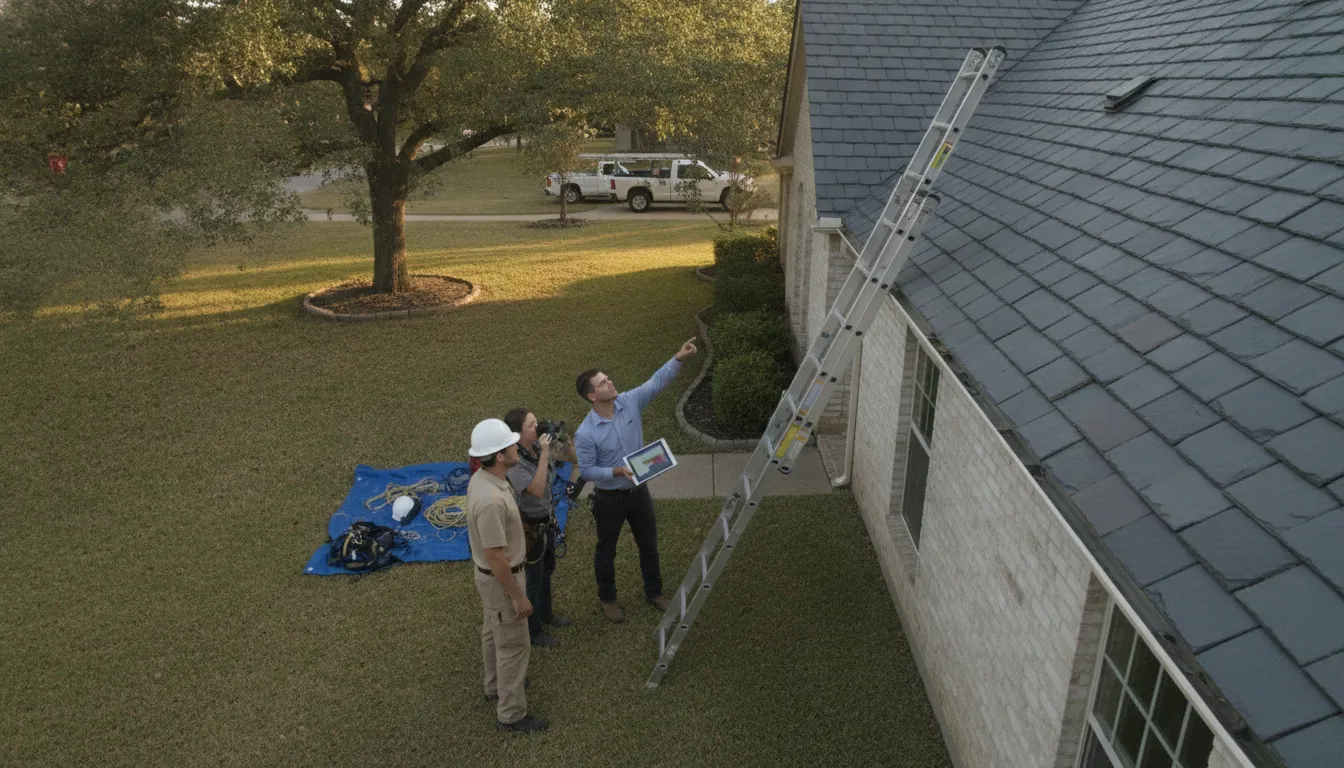
These observations do not establish the severity of the problem by themselves. Hail damage can be difficult to recognize from ground level, while wind and falling debris may affect individual areas without making the entire roof look different. Elevation Roofing's related guide, What Does Hail Damage Look Like on a Roof?, can help property owners understand what to watch for before arranging an assessment.
Plan inspection and maintenance around exposure
A post-storm inspection is useful even when a leak is not immediately visible. The inspection can consider the slate surface, flashing, gutters, drains, vents, fascia, soffits, and other parts of the roof assembly. It may also include moisture detection, hail-damage assessment, and water-ingress evaluation. For Houston and Austin property owners, the timing should reflect the roof's condition, recent weather exposure, and any previous repair or maintenance concerns rather than a one-size-fits-all schedule.
When storm damage is suspected, storm damage roof repair planning should begin with documentation and a professional assessment. Elevation Roofing can assist with damage documentation, adjuster coordination, paperwork processing, and claim support where appropriate, but no inspection can guarantee an insurance outcome. For additional local context, review the company's post-storm inspection guidance for Texas properties. Consistent maintenance, including drainage clearing, debris removal, flashing checks, and minor repairs when appropriate, can help keep a weather-exposed slate roof in better condition between major assessments.
What Should You Ask Before Hiring a Slate Roof Repair Contractor?
Slate roofing deserves a careful hiring process because the visible problem may not reveal the full scope of work. Before approving slate roof repair, ask questions that show whether the contractor understands the material, can explain the proposed work, and will document what the property needs. A thorough conversation should leave you with a clear written plan rather than a rushed recommendation.
Experience and inspection questions
- How much experience does your team have evaluating and repairing slate roofs?
- Will you inspect the roof from a safe position and explain which areas require closer professional evaluation?
- Will the inspection address the slate surface, flashing, underlayment, drainage, vents, and signs of moisture or water intrusion?
- How will you distinguish an isolated repair from a broader restoration or replacement concern?
Property owners should not walk on slate to investigate damage. A qualified contractor should provide a professional evaluation instead. The assessment may include the roofing surface, fascia, soffits, drains, gutters, vents, and flashing, along with moisture detection and water-ingress evaluation when appropriate. You can review the expected inspection scope through Elevation Roofing's free roof inspection service.
Scope, materials, and safety
Request a written scope that identifies the suspected source of the problem and the areas to be repaired. It should explain work needed around flashing or underlayment and how the finished roof will be checked. Ask whether replacement slate will be matched to the existing roof in color, thickness, size, and general appearance. Matching is important for visual consistency and for a repair plan that respects the existing roof. The contractor should confirm what is practical after examining the material in place.
Ask how workers will protect the property, landscaping, and remaining slate during access and repairs. The contractor should also explain how safety procedures affect the inspection and work area. Be cautious of anyone who encourages you to climb onto the roof. Treats every leak as proof that the entire roof must be replaced, or proposes a repair without discussing flashing, underlayment, drainage, and moisture conditions.
Documentation and accountability
If a storm may have caused the damage, ask what documentation will be provided, including photographs, observed conditions, and a description of recommended work. Insurance-claim assistance can include damage documentation, adjuster coordination, paperwork processing, and claim negotiation support, but no contractor can guarantee an insurer's decision or payment. Ask what your contractor will handle and what remains your responsibility.
Confirm who will supervise the project and whether the work is performed by in-house crews or subcontractors. In-house crews can provide a clearer accountability path when questions arise. Also ask how the contractor serves your area and what follow-up maintenance is recommended after the repair. Elevation Roofing serves Houston, Austin, and surrounding Central Texas communities; its Houston and Austin service areas page can help confirm local coverage.
Finally, ask for a maintenance plan that may include inspections, debris removal, drainage clearing, sealant touch-ups, ventilation checks, and flashing inspections. A contractor who can explain both the immediate repair and the next steps for ongoing care is better positioned to help you protect the roof over time.
Frequently Asked Questions
How are slate roofs repaired?
A professional starts by identifying the source of the problem, then evaluates damaged slates, flashing, underlayment, drainage, and signs of moisture. Depending on the findings, the plan may involve repairing a localized leak, addressing flashing, replacing damaged slate with a suitable match, or completing broader restoration work. The right method depends on the roof's condition, installation, materials, and the extent of damage.
Is it worth repairing a slate roof?
Repair can be worthwhile when the damage is localized and the surrounding roof remains serviceable. Replacement may be considered when the roof has widespread deterioration, recurring leaks, or damage that is no longer practical to address through isolated repairs. Slate can have a long service life, but age alone does not determine the best choice. A documented inspection helps compare repair, maintenance, restoration, and replacement options.
Can I repair a slate roof myself?
Slate is fragile, and walking on it or attempting roof work can cause additional breakage and create a fall hazard. Check visible areas from the ground, look for interior signs of water intrusion, and arrange a professional inspection instead of climbing onto the roof. A qualified evaluation can also identify less obvious concerns around flashing, vents, gutters, and drainage.
How much does it cost to fix a slate roof?
There is no reliable one-size-fits-all price. The scope can vary based on the number and type of damaged slates, access, flashing or moisture issues. Underlying damage, and whether the work is a targeted repair or part of a larger project. Request a written assessment that explains the observed damage, recommended work, and any repair-versus-replacement alternatives before approving service.
Ready to Plan the Right Slate Roof Repair?
A professional inspection can help clarify whether visible slate damage calls for focused repair, maintenance, or a broader replacement plan. It also gives you a safer way to evaluate concerns without walking on the roof. For responsive service in Houston, Austin, and surrounding Central Texas communities, call Elevation Roofing & Restoration at (832) 271-1726 to schedule a free roof inspection.